
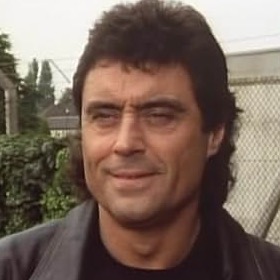
One Wink Plot
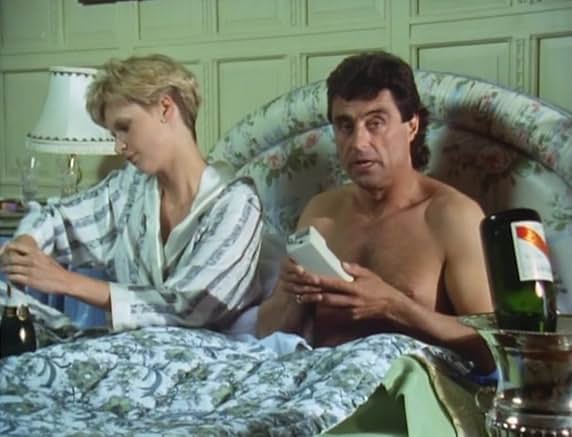
A French gang is stripping country houses back to the floorboards. Lovejoy is hired to sell a retired film star's collection and is in bed with the auctioneer when they get to hers.
Review
It has been a busy weekend. Went to see an R.E.M. tribute act on Friday night at KOKO. The American actor Michael Shannon leads the band as Stipe and they are very, very good. Lifes Rich Pageant in full — no apostrophe, that is how the sleeve has it — and then a good long run of deep cuts. We were all booted out of KOKO about 9:45pm as the nightclub takes over at 10.
The album is forty this year, which is the excuse for the tour, and it also means it came out the same summer that Series One of Lovejoy had finished airing. Everything on this site is 1986 one way or another.
Setlist at the foot of this page. All twenty-nine of them.
Then I went to the Rest Is Fest at the Royal Festival Hall on Sunday. It was good, but persuading people to pay £100 to watch a podcast being recorded is quite an accomplishment by the Goalhanger stable.
Anyway, enjoyable stuff, and my tickets were free, and Anthony Scaramucci is very eloquent. A US Lovejoy. I wonder if Lovejoy would be shilling bitcoin in 2026. I would hope not.
Onto the episode. Like my Sunday at the Royal Festival Hall, it starts abroad — and unlike my Sunday, that usually doesn't augur well.
No subtitles, either. We are simply dropped into France, where a château is being stripped and two gendarmes discover that architectural salvage can be a surprisingly physical business. One of them gets a length of timber across the back of the head before the titles have finished.
So this is another one in the mould of Death in Venice. Lovejoy as Bond. Foreign villains, foreign police, boats, and an antique dealer from East Anglia gradually being promoted into an action hero.
Historically this has not gone well.
National Wealth isn't as bad as Death in Venice. Parts of it are very good. But it isn't classic Lovejoy either, and Janey is absent.
Back home, Eric has returned from the Welsh fishing trip that kept him out of One Born Every Minute. Nothing more is said about it. I don't think Eric ever expresses the slightest interest in fishing again, so this is the Lovejoy equivalent of Uncle Bryn's trip: something happened in Wales and it is probably best for everyone that we never speak of it.
The three of them are reading about a château in northern France sold to a Japanese corporation for ten million francs, its value substantially reduced by thieves who got there before the auction. Eric wants to know whether Lovejoy Associates is ready for 1992 — the episode went out in February 1991, so the single market was still eighteen months off and every business page in the country was asking the same question. Lovejoy's response is that his number one executive decision is whose turn it is to make the tea.
Then he turns to camera and explains architectural theft.
After an entire episode of no wall-breaking — One Born Every Minute gave us a knowing wink and nothing else — it is good to have him talking to us again. And it isn't a throwaway. This isn't somebody slipping a Constable under his coat. These people are taking fireplaces, statues, panelling and anything else they can physically wrench out of a building.
"They tear the sinews and the heart out of the nation. They strip it of its national wealth."
Hence the title. And then:
"What have we got left in England, if not our past?"
A grand speech from a man whose big managerial contribution ninety seconds earlier was working out who was on tea. But that's Lovejoy.
Then the phone rings, and Tinker takes a call for one of Lovejoy Associates' field agents. Madelene Gilbert, retired film star, wants Lovejoy to come to Carlton Grange at three.
At the mention of her name Tinker leaves the room to change, and comes back looking like Toad of Toad Hall.
Madelene Gilbert, it turns out, was one of the great screen idols of Tinker's youth. He reels off Waterloo Bound, Midnight in Mayfair, The Lady in Black and the apparently unforgettable Goddess of Sahara before announcing that by jingo, he is one of those who would give their right arm to meet her, and instructing Lovejoy to drive on.
There is a nice bit of business here where Lovejoy says the films are a bit before our time, Tink — quietly filing himself and Tinker in the same generation. Ian McShane and Dudley Sutton were nine years apart. The programme has always played Tinker as a man from an earlier world, and it gets away with it entirely on Sutton's delivery.
When they finally meet her, he goes full fanboy: she stole his heart when he was very, very young and he has kept it ever since.
"How sad."
Quite Gen Z in its phrasing.
Madelene needs to sell part of her collection because of a death-duty problem, and the death-duty problem is for no real good reason a chimpanzee.
Her late husband made over a deed of gift to Jo-Jo — entered on the paperwork as John Joseph — and omitted to mention to the authorities that John Joseph was a chimp.
The authorities have now noticed and want the original duty.
So typical Lovejoy territory.
Her butler Michael doesn't entirely trust the reputation of the man they have invited in, so Lovejoy is given an instant divvy test — like the NY Times Wordle: two pieces of silver, one repro and one genuine.
Our hero barely needs to look. The plated one is early 19th century, leaden pitch infill, moderate quality, about £8,000. The other is a Paul de Lamerie from around 1730 — a real name, and about as good a one as English silver has, which is why the fifty grand and up doesn't sound like showing off.
Remember the eight grand. It comes back.
Then Madelene turns it round on him.
"You passed my test as soon as you entered the room. One can tell everything about a man by his deportment. If one knows how to look."
The divvy has been divvied. It is a lovely scene, and she gets a Milton quotation in as well — time will run back and fetch the age of gold — which Lovejoy ducks by claiming he thought he was here to talk about antiques.
Eric has never met her at all. He walked up the drive, couldn't get past the less than fearsome Michael, and left a business card.
Anyway that was enough. Eric Catchpole is lead sales person this week.
When Eric starts thinking about the commission, Lovejoy explains that antiques aren't just any old commodity — they have a relationship with their owners. How would Eric feel, he asks, if he found a stranger picking his way through his Led Zeppelin collection?
Eric gets it immediately. There are more important things than money.
Hold on to that one as well.
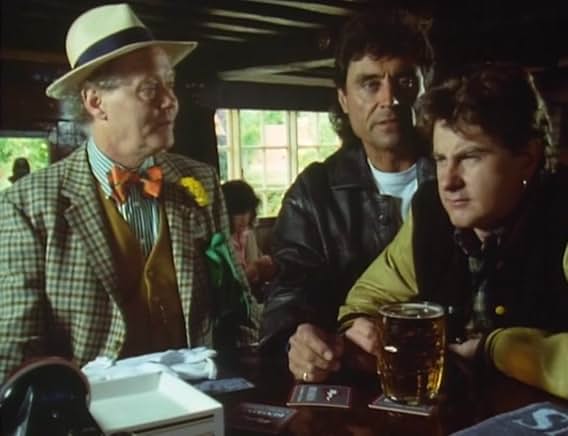
Tinker, meanwhile, celebrates by returning to the pub, settling in at the bar and observing that life is nothing but an endless process of decay.
Then: my usual, thank you.
The opening quarter is a proper romp. Lots of Tinker, lots of Eric, and Lovejoy actually dealing in antiques.
All three of them are in it together and the programme doesn't need anything more complicated than an old film star reluctantly selling her things.
Then the collection needs an auctioneer, and we get Delauneys and a Mel Ford.
Lovejoy walks in asking for Mel Ford, assumes the young woman in front of him is the secretary, and is briskly informed that Melanie Ford is the auctioneer.
He is apologetic for several seconds and then asks her to lunch. She points out that if she had been a man, as he expected, he would not be asking. Certainly not, our ageing cad responds.
Mel is young, blonde, Cambridge-educated, and she seems inexplicably interested in Lovejoy. McShane was 48 when this was made; Edita Brychta was 29. Maybe the 90s were different.
And this is roughly where the episode starts to sag a little - like a middle aged paunch in a Hard Rock Cafe t-shirt.
Miriam breaks down, so Mel gives him a lift — to the enormous house where her father is house-sitting while the owner is abroad. Then she fancies a swim. Then we get a swimming costume scene and one thing leads to another with extraordinary efficiency.
The resulting seduction sequence is more cringe than Tinker and his army mate in One Born Every Minute.
No Janey, a French opening and a weird seduction scene means this episode is dropping points quicker than Spurs.
Unfortunately, while Lovejoy has been enjoying Love, somebody has had a very good go at nicking all of Madelene Gilbert's house. Paintings and furniture gone, panelling gone, some of the floorboards gone. And the staircase.
Michel Le Mor — the Frenchman we watched flatten a gendarme in the opening scene — turns out to be one of Mel's previous squeezes, and he looks about the same age as Lovejoy, which rather undercuts the fuss the episode makes about Mel's youth.
Lovejoy at least has a comprehensive alibi. Mel supplies it to Detective Sergeant Armstrong in the plainest available terms: they spent most of the time in bed, making love.
An alibi Lovejoy needed rather more than the viewer did.
Madelene has no insurance — her husband didn't think they needed it and said they couldn't afford the premiums, but could afford a chimp it seems — so there is no cushion at all. And then Mel dumps him, which leaves Lovejoy without the woman or the antiques. Tinker's summary is that there are two things in life Lovejoy holds dear, and Eric supplies them: women and antiques. Right now both have been taken away from him.
It is Eric, though, who asks the question that saves the episode. Nicking a painting is one thing, but a staircase? How do you even move something like that, never mind sell it?
Where do you sell a staircase?
Lovejoy works the architectural-salvage yards — Tinker reckons there are only three or four in the whole of London dealing in that quality — and is pointed at a Major Sullivan, ex-SAS, hard as a rock, operating out of a boat moored near Windsor. Lovejoy introduces himself as Roger Hyatt of Hyatt and Hyatt Antiques, Epsom. Sullivan asks for a card.
"Left them in the Porsche."
He is not convincing.
The police are already watching Sullivan, and Armstrong hauls Lovejoy into a car to explain that the man he has just been bothering is a Falklands veteran who served in Northern Ireland and advises Scotland Yard and Interpol. Lovejoy claims he was asking about buying medals and is threatened with the river. We also meet Adjudant Alain Bernard of the French gendarmerie, who has been chasing this gang for years and wants to talk about a murdered policeman.
At which point Lovejoy has to explain the plot to us while driving.
Never a good sign. Last witnessed in the second half of the Death in Venice debacle.
It does at least buy us a view of Windsor Castle, where one of my favourite kings is buried — Edward IV, who started building St George's Chapel in the first place and then ended up in it. A nice Wars of the Roses crossover in the middle of a programme about fireplaces.
What follows may be the reason the episode survives.
Lovejoy sends Tinker and Eric to watch the Ocean Roamer II in the middle of the night, and Tinker's first move is to suggest obtaining further refreshment on the way. Eric sits about listening to rock music on headphones. The engines start. Sullivan leaves. Neither of them notices.
They have lost a boat.
Not a bloke slipping out of a back door. Not a Sierra disappearing into traffic. A boat.
So they decide to give chase, and they hire a punt.
"When I said hire a boat, I meant hire a boat with an engine!"
"This is all they had left."
Completely ridiculous, completely them, and a nice callback to The Firefly Cage, the last time Tinker found himself on the water. Booze was involved that time too — he gave up the last of his whisky to soak a mop so Lovejoy could set fire to it. The man has form.
Then Lovejoy gets there. The French château was on the water. Carlton Grange was on the water. Sullivan has a boat.
That's how you steal a staircase. You float it away. We had a staircase story in The Real Thing as well — Series One, episode seven — where Lovejoy nicked a wrought-iron spiral one off Gimbert to settle a promise to Lady Jane. Good to see some stairs taking centre stage again.
It is a good solve, and it is the only real piece of divvying in the back half. What never quite gets explained is why Sullivan has become the main man in all this — he arrives as a tip-off from a salvage yard and is running the operation by the third act with no particular reason given.
The next target is Higham Hall, which looks a bit like the White House sans the Trump extension, and by now the gang's operation has become enormous. Trucks, boats, a helicopter. Michel asks Sullivan how he intends to move a garden statue and gets told he'll make her fly. Of course he will. The budget has plainly gone up this week — although I still don't see how the Ocean Roamer II fits an entire house in it, staircase included, even with a tug alongside.
The final act is utterly bonkers. The crooks are in the process of taking everything, and then the gendarmes and the Met both turn up at once, in an act of Anglo-French collaboration that would be handy in Normandy at the moment.
And somewhere in the middle of an international armed-police operation, Lovejoy is taking an inventory. Two 18th-century chiffoniers. Four Bergama rugs. Four Hepplewhite dining chairs, Eric.
That is why National Wealth gets away with it. Death in Venice gradually forgot what programme it was. This one has Lovejoy standing in the middle of what has become a Bond film, still looking at the furniture.
Michel gets away on his boat, pursued by the French policeman, Lovejoy and Mel — but Tinker has got himself aboard and nobbles the engine, so Michel switches to a dinghy and we get a Bond-like chase which ends with him in the water shouting for Lovejoy, of all people, to help him. Then Bernard shoots him.
Which is the point to mention that the man is called Le Mor. One letter off le mort, and he is the only person in the episode who ends up dead. This is the same programme that gave Ded Lizards to Montezuma's Revenge, so it is fair to assume the joke is deliberate.
Tinker saves the day. Sort of.
A truly ridiculous episode that is actually quite entertaining.
And for once, the antiques actually look like they might be worth something.
Madelene's collection is convincing: good furniture, serious silver and a house full of things that look as though they have been accumulated rather than borrowed from the props department that morning. The de Lamerie test works partly because you can believe either piece might matter.
That continues when the thieves start stripping the houses — panelling, fireplaces, rugs, floorboards and an entire staircase. National Wealth is unusually good at making the antiques look like national wealth.
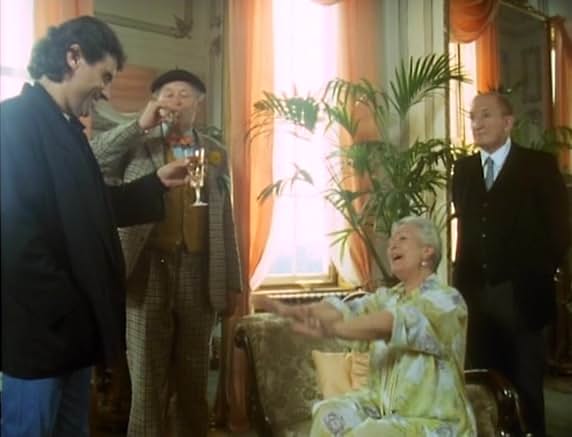
Back at Carlton Grange, Madelene wants to say thank you. Lovejoy gets the silver from his divvy test, and asks whether she is sure it isn't the original de Lamerie. Of course not, she says. It's a copy.
Tinker, after an entire episode in awe of one of the great stars of his youth, is offered whatever he likes and asks for her autograph. Perfect.
Then Mel turns up at Lovejoy's needing £8,000 for her father's bail — he was working with Michel — and Lovejoy looks at the silver he has just been given. Which, if you were paying attention in the first twenty minutes, he valued at about eight grand.
There are more important things than money, he told Eric.
"Easy come, easy go. We'll get him out. In the morning."
And then another love scene.
Favourite Moment
Tinker and Eric losing a boat.
Not a man. Not a car. A boat, with engines, on a river, in the dark, while both of them were sitting there looking at it. And then the decision to pursue it — by punt, because it was all they had left.
Everything around it is helicopters and Interpol. That bit is two blokes and a pole.
Good Quote
"By jingo! I'm one of them. Drive on!"
Guest Focus — Jean Kent & Ronald Fraser
Madelene Gilbert is Jean Kent, and the casting is the best joke in the episode because it isn't a joke.
Kent was a genuine article: signed to Gainsborough Pictures during the war, and one of the four Gainsborough Girls alongside Margaret Lockwood, Phyllis Calvert and Patricia Roc. Fanny by Gaslight in 1944 was the turn, and Caravan, Good Time Girl and Trottie True followed. She was 69 when this was filmed and had been off screens for long enough that the retirement in the script needs no acting at all.
Which means Tinker's reverence isn't invented. Waterloo Bound and Goddess of Sahara are made up, but the woman being fawned over really was one of the biggest stars in British cinema, and the script knows it — Tinker's explanation of why the butler is trustworthy is that he was her dresser at Gainsborough Pictures. That is the actual studio. Somebody in the writing room did their homework.
She died in Bury St Edmunds in 2013, aged 92, which puts her in Suffolk at the end. Fitting for this programme.
And the butler is a returning face, which is the bigger news. Michael Edwards is Ronald Fraser, who was in the very first episode of Lovejoy — The Firefly Cage, five years earlier, credited as Drummer. Same show, different man, nobody mentions it.
Fraser was one of those faces that turn up everywhere in British film without ever quite headlining: Sergeant Watson in the original The Flight of the Phoenix, The Killing of Sister George, Too Late the Hero, The Wild Geese, and the sitcom The Misfit. Nearly fifty films, mostly comedies, usually as somebody you wouldn't lend money to. He died in 1997, six years after this.
He is very good here, and doing something quite specific — the butler is the one who doesn't trust Lovejoy, sets the divvy test, breaks the news of the robbery and stops his employer walking into the wreckage of her own drawing room. Eric's theory that the butler did it is the natural conclusion and the episode is careful to close it off: forty years of service, and if she goes he inherits the lot anyway.
The Divvy Verdict
A 3.5. National Wealth should be worse than it is.
Lovejoy-as-Bond is rarely good Lovejoy, and for a while this looks like going the same way as Death in Venice: a foreign opening, an international gang, a policeman from another country and the plot being explained to us through a windscreen. Then a helicopter arrives.
But there is a difference, and it is a simple one. The antiques never completely disappear, and neither do Tinker and Eric. The first quarter is proper Lovejoy — Eric accidentally winning the firm some work with a business card, Tinker dressed as Toad of Toad Hall, a film star divvying the divvy, death duties caused by a chimpanzee, and the gang arguing about the emotional relationship between people and their possessions. Even once the plot goes berserk, Tinker and Eric are there to puncture it by losing an enormous boat and setting off after it in a punt.
What holds it at 3.5 is everything in between. Janey is missed — this is the second episode running without her, and the second running where somebody else has to do her job of getting Lovejoy through a front door. The Mel romance does nothing for me and the swimming-pool business is the episode's low point. And whenever Lovejoy starts solving international crime rather than trying to make a few quid out of an antique, the series mislays some of what makes it special.
Underneath it, though, this is an episode about people losing things they cannot replace, and it is more serious about that than the helicopters suggest. A woman is selling her possessions because of a paperwork error involving a chimp, and then has them taken anyway, and she has no insurance. The thieves aren't after value, they are after the parts of a building that cannot be put back. Lovejoy's speech to camera is about a nation; the plot is about one elderly woman's staircase. Both work, because they are the same point at different sizes.
And then he hands over the silver for a bail bond, having spent the episode telling Eric there are more important things than money. Eight grand of it, handed over without a second look. Underneath the gendarmes, the SAS major, the swimming costumes and Tinker chasing an international criminal in a punt, that is quite a neat little ending.
Which answers my own question from Friday night, I think. No, Lovejoy would not be shilling bitcoin in 2026. The whole point of him is that he cares about the object and not the number, and this is the episode that proves it — the one where he could have banked the de Lamerie and instead gave it away in the morning.
And on the other thing. What Michael Shannon and his band are doing at KOKO is playing somebody else's record note for note, and it works because they clearly love the songs more than they want the credit. National Wealth is Lovejoy doing a Bond tribute, and it works for exactly the same reason. Somebody in the middle of the helicopters and the armed police is still counting the Hepplewhite chairs.
Unlike Death in Venice, it is never boring.
R.E.M. at KOKO, 4 September 2026
Michael Shannon & Jason Narducy and Friends, playing the fortieth anniversary of Lifes Rich Pageant. Shannon and Narducy out front, with Jon Wurster on drums, John Stirratt of Wilco on bass, Dag Juhlin on guitar and Vijay Tellis-Nayak on keys.
The album, in full and in order — all twelve, side one and side two, exactly as it was sequenced in 1986:
- Begin the Begin
- These Days
- Fall on Me
- Cuyahoga
- Hyena
- Underneath the Bunker
- The Flowers of Guatemala
- I Believe
- What If We Give It Away?
- Just a Touch
- Swan Swan H
- Superman
Then the deep cuts, which is where it got interesting — thirty years of the catalogue in no particular order at all:
| # | Song | From |
|---|---|---|
| 13 | Lotus | Up, 1998 |
| 14 | Harborcoat | Reckoning, 1984 |
| 15 | Fretless | Until the End of the World soundtrack, 1991 |
| 16 | Gardening at Night | Chronic Town EP, 1982 |
| 17 | How the West Was Won and Where It Got Us | New Adventures in Hi-Fi, 1996 |
| 18 | Me in Honey | Out of Time, 1991 |
| 19 | The Lifting | Reveal, 2001 |
| 20 | E-Bow the Letter | New Adventures in Hi-Fi, 1996 |
| 21 | Burning Down | 1985 B-side, later on Dead Letter Office |
| 22 | You Are the Everything | Green, 1988 |
| 23 | The Great Beyond | Man on the Moon soundtrack, 1999 |
And the encore, which is half Murmur and none the worse for it:
| # | Song | From |
|---|---|---|
| 24 | Nightswimming | Automatic for the People, 1992 |
| 25 | Pilgrimage | Murmur, 1983 |
| 26 | Sitting Still | Murmur, 1983 |
| 27 | Crush with Eyeliner | Monster, 1994 |
| 28 | Radio Free Europe | Murmur, 1983 |
| 29 | Star 69 | Monster, 1994 |
Twenty-nine songs and out by quarter to ten, because the nightclub wanted its room back.