
One Wink Plot
The murder of Campie drags Lovejoy from Suffolk to Venice, where a simple question about forged Renaissance paintings unravels into an underground forgery workshop, identical twins, shifty Australians, undercover police officers and a criminal network run by the urbane Pinder. Double-crosses pile onto fake identities until even Lovejoy admits "everything got blurred" — and he should know, because he has to explain the whole conspiracy twice before anyone lets him go home. Fortunately Suffolk, Lucky Luciano and one perfectly timed question from Lady Jane are waiting at the other end.
Review
"I know, it's pathetic."
The World Cup has ended. I'm writing this exactly a week after a great tournament finished with a massively disappointing final. At least the Argies didn't win.
Quite aptly, Lovejoy Series One also ends with the massively disappointing Death in Venice, parts one and two. This double-header is an absolute mess — much like the World Cup half-time show. And much as with the original Ronaldo and Ronaldinho appearing in a go-kart with Madonna, I'm not sure even Pelé appearing on a gondola could have saved it.
Also like the World Cup, it'll be a few years — five, in this case — until we get another outing. Death in Venice was very nearly the death of Lovejoy.
I'm reviewing this as a single episode because a) I don't want to write two reviews for this mess, and b) I don't want the overall Series One score dragged down by two horrible episodes.
This story went out in 1986 and was probably filmed in 1985, at a time when there was no James Bond in place. Roger Moore had retired after A View to a Kill — reportedly after realising he was older than the mother of his leading lady, Tanya Roberts — and part of me thinks this was McShane auditioning for the role. We have Pinder in his wheelchair as the Blofeld-style baddie, with a plot to remove all of Venice's artwork that's only marginally less silly than the one in On Her Majesty's Secret Service, where Blofeld sets up a clinic in the Swiss Alps, recruits a dozen young women with various allergies and hypnotises them into carrying bacteriological agents to wipe out the world's crops and livestock.
Anyway — I don't think McShane was ever in with a shout for Bond, but part of me would love to have seen him abseiling into Gibraltar as Dalton eventually did in the opening of The Living Daylights. Could have been Lovejoy.
McShane pulls in his real-life wife, Gwen Humble, to play two parts as the twins Caterina and Lavinia — and incredibly, this is nowhere near the worst thing about the episode.
Once again the story starts in Suffolk, and all is well. Nice shots, a slightly upsetting murder, and we're off.
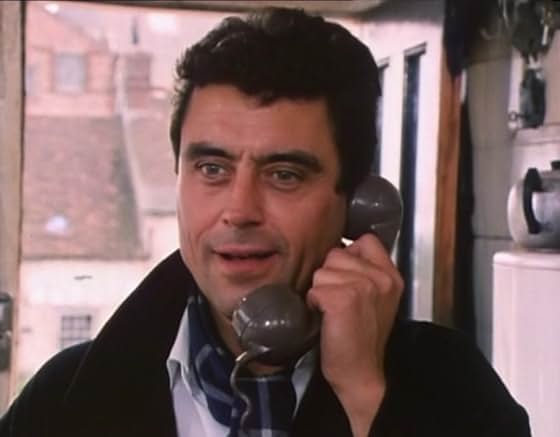
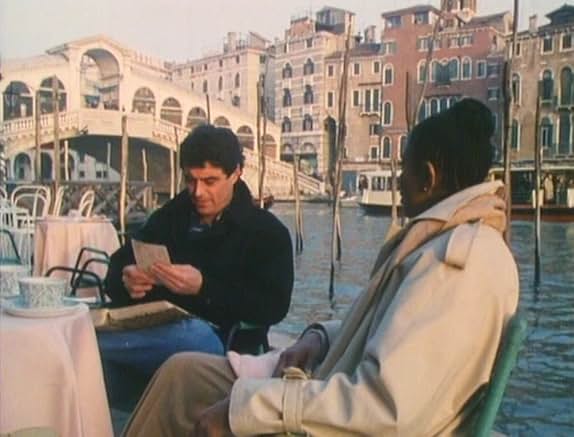
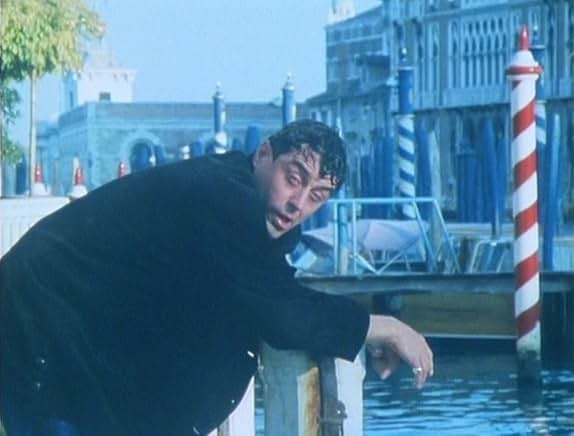
Unfortunately, we're off to Venice. Now, I went to Venice in the early 90s as part of an Inter-Railing break — about seven years after this was filmed — and having never been back, the episode does remind me of what I saw. So you'd think some nostalgia points would be awarded. But no. I'm not sure why we're there, and neither does anyone in the cast seem to be sure. Someone attempts to explain the plot about three or four times. Lovejoy goes into the Venice lagoon twice, just so we're aware he is in Venice and that Venice has water.
Part one ends on a cliffhanger with a very odd shooting — reminiscent of the ending of Get Carter (the Michael Caine Geordie original) but without any of the plot leading up to it.
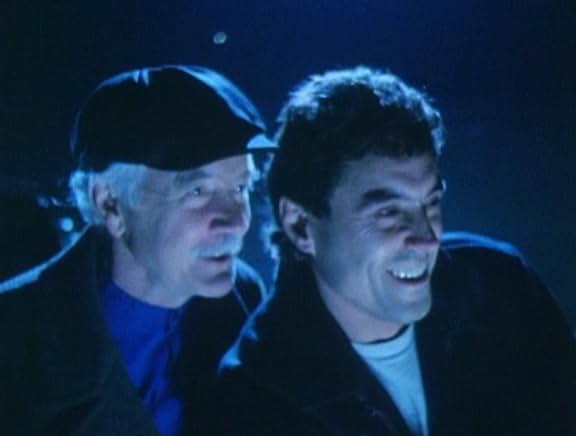
Part two is better: Fulton Mackay turns up and saves the episode. His expert-forger schtick works nicely alongside Lovejoy. Mackay passed away before Series Two came around, but I can't help feeling Lucky would have been a brilliant addition to the regular cast — and with the La Frenais link between Lovejoy and Porridge, they could certainly have made it work. Imagine if Norman Stanley Fletcher had made a crossover appearance. That thought makes me happy.
Anyway, the story ends with Lovejoy and Lucky bringing the whole sham down by pulling a Venetian wall over with a boat, flooding the forgery centre that was copying Venice's artwork so Pinder could make off with the real stuff. Truly insane. And not insanely entertaining, unfortunately.
I think the scriptwriters understood this, because one of the final scenes is back in the pub in Suffolk — and this pub scene looks better than all the Venice scenes combined — with our famous five (Janey, Gimbert, Tinker, Eric and Lovejoy) trying to explain away what has happened over the previous two hours. It still makes no sense.
The final exchange with Jane is great, as she openly admits she's jealous at the thought of Lovejoy sleeping with one of the many women he met on his Venetian jaunt. A fantastic bit of dialogue — up there with Han Solo just before he gets carbonited:
Lovejoy: Lady Felsham, I do believe you're jealous.
Jane: No, I am not!
Lovejoy: Yes, you are.
Jane: I know, it's pathetic.
So, without overdoing the Star Wars comparison, the BBC — like Boba Fett — take Lovejoy away for a few years. We will return, and Series Two is right up there with Return of the Jedi. The series will be unfrozen. We'll have moved into the 90s, and while it may only have been five years, the Britain that Lovejoy returns to feels completely different.
Bring. It. On.
Guest Focus — Fulton Mackay & Gwen Humble
To an entire generation Fulton Mackay will forever be Mr Mackay, the parade-ground prison officer glowering at Ronnie Barker across the landings of Porridge. Here he turns up as the splendidly named Lucky Luciano — no relation, presumably, to the New York mob boss — and proceeds to walk off with every scene he's given. His unexpected reappearance in Suffolk for the final act is one of the two-parter's genuine pleasures.
The other notable piece of casting is Gwen Humble, who plays both Caterina and Lavinia — and who happened, at the time, to be Mrs Ian McShane in real life. Playing identical twins opposite your own husband while he romances his way around Venice is a curious day at the office, but she handles the dual role convincingly, which is more than can be said for some of the plot around her.
Trivia & Observations
- Part One aired on 7 March 1986 and Part Two on 14 March 1986, the week after The March of Time.
- It was also the Series One finale — and the last new Lovejoy on British television for nearly five years. The BBC didn't bring the series back until January 1991.
- The story draws on Jonathan Gash's 1984 novel The Gondola Scam, while the title tips its hat to Thomas Mann's novella (and Visconti's 1971 film) — lofty company for a show about a Suffolk antiques dealer.
- The climactic escape is scored with a jaunty variation on the Lovejoy theme, which rather undercuts any tension the sequence was hoping to build.
- The plot becomes so involved that Lovejoy delivers two full explanations of it — once to Cosima after she's shot, and again back in Suffolk for Jane, Eric, Tinker and Gimbert.
- Gimbert's end-of-series audit: "Sod all to show for it again."