
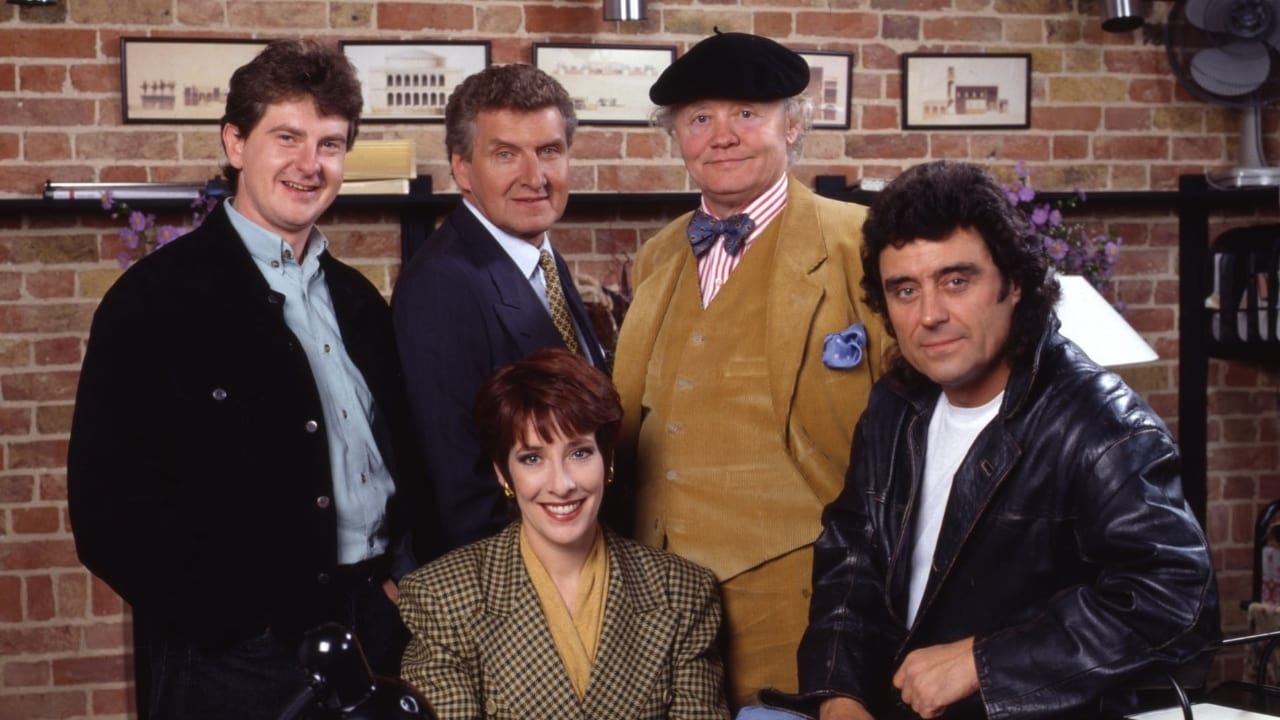
The show
Lovejoy is a BBC drama that ran from 1986 to 1994. It follows the wheelings and dealings of a roguish East Anglian antiques dealer who keeps tripping over murders, frauds and forgeries while trying to make rent. It is, ostensibly, a show about antiques. It is, in practice, a show about Ian McShane being enormously charming at people.
Famously, Series 1 aired in 1986 and then nothing happened for five years — the BBC didn't bring it back until Series 2 in 1991. After that wait, though, it ran like clockwork: Series 3 in 1992, Series 4 and 5 in 1993, Series 6 in 1994. As regular as buses, once one finally turned up.
The people
Lovejoy — the dealer himself. Has a "divvy", which is to say a sixth sense for spotting genuine antiques in piles of tat. Largely uses this gift to make slightly less money than he should.
Eric Catchpole — Lovejoy's apprentice, broadly the mechanism by which things go wrong. Means well. Reads things badly. Wears jumpers.
Tinker Dill — Lovejoy's barker: the man who drums up trade, sniffs out leads at fairs and in pubs, and arrives with information for sale at the price of one more drink.
Lady Jane Felsham — friend, foil, and source of most of the show's running tension that the writers will absolutely not resolve, thank you very much.
Charlie Gimbet — foe, landlord, fellow antiques dealer. Not a divvy. Tom to Lovejoy's Jerry.
Dandy Jack — a disappointment. Neither foe or ally. Dropped after one season. Basically Jar Jar Binks.
Behind the cast
Ian McShane (Lovejoy) trained at RADA alongside Anthony Hopkins and John Hurt, and apparently only ended up there by happy accident — he broke his leg playing football and, while laid up, was talked into the school production of Cyrano de Bergerac. Before he was charming us out of our chequebooks as a divvy, he'd already been Heathcliff in Wuthering Heights (1967), Judas Iscariot in Jesus of Nazareth (1977), and a cockfighting Englishman in Roots. He was a 1970s pin-up before he was a 1990s heartthrob in a leather jacket. The man has been famous for so long he's practically antique stock himself.
Phyllis Logan (Lady Jane Felsham) had already won a BAFTA for Most Promising Newcomer (for Another Time, Another Place, 1983) before Lady Jane raised her first amused eyebrow at Lovejoy. Two decades later she'd find another BAFTA-adjacent national-treasure berth as Mrs Hughes in Downton Abbey — which means she's spent a remarkable chunk of her career being the sensible one keeping a charming chaos-merchant in line. From a Paisley girl with the James Bridie gold medal to twice the moral compass of two beloved British dramas — quite the run.
Dudley Sutton (Tinker Dill) — and this is the killer fact — was expelled from RADA for "responding to rock-and-roll". Before that he'd served as an RAF mechanic. His pre-Tinker career was startlingly edgy: he played a gay biker in The Leather Boys (1964) when that was genuinely controversial, originated the title role in Joe Orton's Entertaining Mr Sloane on stage, and turned up in Ken Russell's notorious The Devils (1971). So the rumpled, whisky-fond, conspiratorial old soak we adore was actually one of the most quietly transgressive British actors of his generation. He died in 2018, aged 85.
Chris Jury (Eric Catchpole) read Drama at Hull University and worked early on with Danny Boyle and Anthony Minghella before they were those Danny Boyle and Anthony Minghella. The most delightful what-if: on the back of Lovejoy he was a serious contender to play the Seventh Doctor in Doctor Who in 1987 — the role went to Sylvester McCoy, but Jury later turned up in the show anyway in The Greatest Show in the Galaxy. He moved into directing and screenwriting after Lovejoy.
Malcolm Tierney (Charlie Gimbert) — Lovejoy's perpetually exasperated rival auctioneer — had a CV that reads like a tour of British prestige drama: Captain Monk Adderley in the original Poldark, Patrick Woolton in House of Cards, plus Tommy McArdle in Brookside. Most surprisingly, his first major film credit was Star Wars: Episode IV. Yes, Charlie Gimbert was in Star Wars. He also popped up in Braveheart and In the Name of the Father. He died in 2014.
Behind the page
Jonathan Gash is the pen name of John Grant, born in Bolton in 1933. The quietly remarkable thing about him is the day job: Grant was a pathologist and bacteriologist — a proper one, not a cosy-mystery vicar's assistant. He worked in England, Germany and Hong Kong (where he taught himself Cantonese for the job), and from 1971 to 1988 he was Head of Bacteriology at the London School of Hygiene and Tropical Medicine. He wrote his Lovejoy novels around all this. The first one, The Judas Pair (1977), won the Crime Writers' Association's John Creasey Award for Best First Crime Novel. He went on to publish more than twenty Lovejoy novels between 1977 and 2008, finishing with Faces in the Pool. The TV adaptation only really mined the books for Series 1 (1986); from Series 2 onwards the writers' room invented its own scams, which is partly why the show is jollier than the books — Gash's Lovejoy on the page is a darker, lechier, more cynical creature than McShane's twinkling chancer.
Dick Clement and Ian La Frenais, on the other hand, are pretty much British sitcom royalty — the kind of pedigree where you stop counting national treasures after the third one. Both born in 1937, they've been writing together for over sixty years, and the back-catalogue is faintly absurd: The Likely Lads (1964), Whatever Happened to the Likely Lads?, Porridge (and its sequel Going Straight), Auf Wiedersehen, Pet, plus the films The Commitments, Still Crazy and Across the Universe. They picked up the Peter Sellers Award for The Commitments and OBEs apiece in 2007. Their 2019 joint memoir is, inevitably, called More Than Likely.
Their actual episode count on Lovejoy is more modest than the marquee billing suggests. They're credited with developing the series for television and writing the pilot itself, "The Firefly Cage" — but most weekly episodes were written by other hands (Ian La Frenais and Dick Clement come and go on the credits rather than carry the load). Their named credits include "Just Desserts" (1991) and the 1992 and 1993 Christmas specials "The Prague Sun" and "The Lost Colony", plus "Last Tango in Lavenham" (1994). So the total is small — somewhere in the region of half a dozen episodes — but their fingerprints are all over the tone: the cheeky direct-to-camera asides, the warmth toward dodgy characters, the affection for chancers who never quite get caught. Anyone who's met Norman Stanley Fletcher will recognise the DNA in Lovejoy. There's a reason the show feels so fond of its hero even when he's plainly fleecing someone.
A note on timing: 2026 marks forty years since Series 1 aired, and a reboot is rumoured to be in the offing — See-Saw Films (the Slow Horses people) are said to have picked up the rights to the novels. Which raises the urgent personal question of whether I'm going to make it through all seventy-odd original episodes before the new show airs. Whether See-Saw can out-twinkle McShane is the question of the century either way.
What "the divvy" means
A divvy is the gift that lets Lovejoy spot the real thing — the genuine Sheraton chair in a barn full of reproductions. It's never really explained, only demonstrated, usually with Lovejoy going quiet, picking something up, and giving it a long look. It is also the reason this site is called what it's called.
Why the show works
On paper, Lovejoy is a nothing show: a likable rogue stumbles around East Anglia having a picaresque. In practice it works because the cast genuinely seem to like each other, the country lanes look gorgeous, the antiques feel like real objects with real histories, and McShane breaks the fourth wall just often enough to make the audience feel complicit.
It's gentle without being twee, and clever without being smug. Most weeks it asks very little of you and gives quite a lot back. We're here to write about it.
Where to watch
In the UK, all six series of Lovejoy are streaming on Channel 4. For other regions — or to check current availability — JustWatch keeps a tidy list.