
One Wink Plot
Tinker's old army mate opens a restaurant with no money in it. A £300 piano, a doctored set of silver, and the whole gang given something to do.
Review
As promised, I am hacking out this review for a lovely episode before I head off to White Hart Lane — aka the Tottenham Hotspur Stadium — for the first home game of the season. Well, the first Premier League home game. Spurs beat the Charlton B-side in the League Cup on Wednesday, at home.
It has been a busy week that got off on the wrong foot with a Monday night curry and far too many beers. Far too many pubs in the days after, and a general feeling of malaise by the time I write this.
Who Dares Sings is an absolute banger of an episode, and nice and simple with it. So is the next one, One Born Every Minute. Generally I am sitting here thinking how good Series Two has been.
Hoping I will be singing later. Let's see.
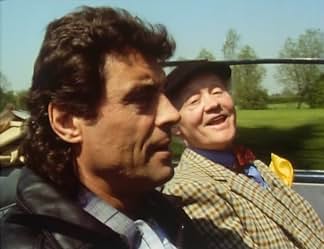
The opening is a Suffolk Doc Hollywood. Car on a country lane, radio on, no particular hurry. Except it isn't, because Doc Hollywood did not reach cinemas until August 1991 and this went out in February, so for once we got there first. And instead of Michael J. Fox we have Tinker in a beret, singing along to The Gnu Song on the car radio while Lovejoy grips the wheel and declines to join in.
"What does go on under that beret?"
"Memories, Lovejoy. Memories."
Then the summary of everything about to go wrong, delivered before anything has: bonkers, broke and an old buddy of Tinker's. Not, as Lovejoy notes, the best credentials in the world.
The client is Major Linden Walker, and the job is another of Janey's contacts. But to be fair to Janey, the introduction isn't the direct problem. Lovejoy's naive greed is.
Jane decorates, Lovejoy furnishes, Linden pays. Only Linden has spent the lot on renovation, so there is no third part. "Him not pay, me go," says Lovejoy, in a homage to Yoda.
What Linden has instead is Aunt May's silver — two bowls, Paul de Pomerey, supposedly forty grand — and three days until the civilians arrive to visit his pub-restaurant.
So: a McGuffin of sorts, and a deadline. A nice simple episode.
Enter George Palmer, and I had it wrong for twenty minutes on first viewing. Palmer is a screw. Not an old cellmate. He was a prison officer on Lovejoy's landing, sat through Lovejoy's lectures apparently, then took his pension and set up in house clearance.
Palmer's assessment of Tinker — a man of fifty who has been half cut since Coronation Day — is roughly how my sister-in-law describes me, with Coronation Day replaced by Black Wednesday.
Palmer also gets a good scene with Eric, who is gluing a chair back together with the same stuff Chippendale used, because "authenticity, that's my trademark". Palmer asks whether he has never heard of superglue. One week after a heavy metal drummer superglued a pre-Columbian king to his dashboard in Montezuma's Revenge. Two episodes running. Glue-themed. Pritt Stick.
Eric also supplies a nice line on Lovejoy's finances. Lovejoy borrowed twenty quid off him on the Friday morning in order to make up his wage packet on the Friday evening. "My mum says it's robbing Paul to pay Paul."
The con itself is very tidy, and for a person with a low attention span, satisfyingly understandable.
Palmer takes Lovejoy round Dashwood House, they agree six thousand for the furniture and the bits, three grand each.
Angela Moxon does the hostess bit and makes the coffee. Now, it is suggested later in the episode that Lovejoy was lured in by the beauty of Angela, but the two of them barely interact, so I wonder whether there was a deleted scene that went without anybody checking the later ones — where the policeman waxes on about her and about how beguiled Lovejoy was.
Anyhoo. Angela's sister works in a travel agency, apparently, which is how they know whose house is empty.
"I just burgled a house and paid three grand for the privilege," says Lovejoy later, to Janey.
Jane, meanwhile, is being called crumpet by Palmer, and takes him apart without raising her voice.
"Crumpet, as far as I'm aware, is a cake one cooks on a griddle."
Phyllis Logan gets more to do here than in the last three episodes put together, which is welcome, as she is great.
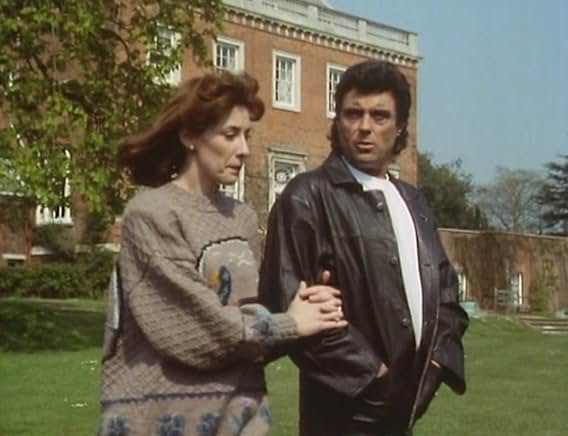
The duck jumper is quite something as well.
Lord Felsham is away again, so Janey loosens up again, and holds off telling the police that Lovejoy has burgled Dashwood House — which turns the whole episode into a simpler thing than it looks.
It is not a whodunnit. It is a man trying to get his three grand back. A precursor to The Streets' A Grand Don't Come for Free, which I saw performed at Ally Pally recently, and which was magnificent.
Along the way we get: Tinker thumping a chord out of the wrecked piano and announcing "Stockhausen." Miriam impounded for bald tyres, no MOT and no insurance, then lent out by the garage to a darts team for an away match.
And the chase — police, Miriam, a decrepit piano on the back and a beautiful spring day. "Richard Clayderman?" "No. Eric Catchpole."
The pubs are the other reason this looks so good. The Three Horseshoes is named on screen, in the invented village of Pillbridge, and it and the White Hart are now both on a list of places I intend to visit in 2027. In the Three Horseshoes somebody throws 84 at the darts. I added it up. It is correct. Well done, props.
Also spotted: a huge Co-op box of multipack crisps, which put me straight back to working at the Safeway in Faversham in the early nineties.
And the Lazer crash helmet is back. In Just Desserts it was Eric's, and I went on at some length about it. Classic nostalgia. Here Lovejoy and Tinker are wearing the very same one, passed between them like unhygienic ten-pin bowling shoes.
The plot resolves twice over, in opposite directions. Aunt May's forty-grand silver is a fake — de Pomerey's mark scratched off and the hallmark altered, because as an antique the bowls were taxable and as silver gilt they were not. She knew all along. Three grand, tops. Meanwhile the £300 piano Lovejoy did not want turns out to have been propped up at one end by a pile of old books, one of which is a 1532 Chaucer.
I have a soft spot for Chaucer, as a) I was born in Canterbury and b) I like medieval history and fart jokes.
I digress. It makes sixty thousand. Lovejoy hands it to Linden, khaki being thicker than water.
Aunt May moves in permanently, in exchange for the silver, and will not be washing up.
She and Linden look roughly the same age, which nobody mentions.
The opening night is a costume party, the Dashwood House couple turn up in it, and Lovejoy gets found out over the tablecloths. Then Hardwick — "My name's Hardwick, by the way. But you can call me Bill" — gives him a week, and Lovejoy uses it to put Palmer and Angela in a house he knows they will do.
And then the last thirty seconds. Jane asks which house. Lovejoy doesn't have to say.
It was hers.
Favourite Moment
The chase. Miriam wheezing along a Suffolk lane in spring sunshine with a knackered piano strapped on the back, police behind, and Tinker performing throughout. The Sergeant asks where they are taking the piano. "To a restaurant." "Peckish, is it?"
Nothing about it is necessary to the plot. It is the programme enjoying itself for four minutes, and it looks good doing it.
Good Quote
"What does go on under that beret?"
"Memories, Lovejoy. Memories."
Guest Focus — John Wells
Linden Walker is played by John Wells, who is an unlikely person to find running a failing restaurant in Suffolk. Wells co-wrote Mrs Wilson's Diary for Private Eye, then invented the "Dear Bill" letters with Richard Ingrams — Denis Thatcher's imagined correspondence, which ran for a decade. He built it into the West End farce Anyone for Denis? and played Denis himself. He then played Denis Thatcher again, properly, in For Your Eyes Only. He died in 1998.
So he knew exactly what he was doing. Which brings me to the double act.
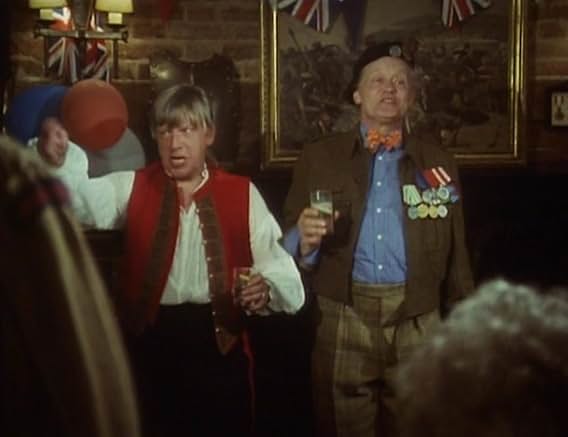
Crime and Punishment — Linden and Tinker's national service cabaret turn, reunited for the opening night — is excruciating. Two grown men and a Flanders & Swann number about a London bus, performed with total commitment and no discernible talent, to a room of people in fancy dress.
It is roughly as entertaining as Mrs Brown's Boys. The script says it is making its first and last appearance, and I was glad to read it.
But it does pay off the title, and it hides the episode's actual secret, which Lovejoy works out and then lets go: Major Crime is Linden and Corporal Punishment is Tinker. Tinker was never brass. He was rank and file. It doesn't matter.
The Divvy Verdict
This was a five. Low-key, beautiful to look at, and the whole gang prominent for the first time in the series — Tinker with a real storyline, Eric with the best lines, Jane at full strength. No murder. Nobody leaves East Anglia. Perfect Lovejoy.
Then somebody turned up to the party dressed as Hitler.
So it is a four and a half, and the missing half is entirely Adolf's fault. I would also like Gimbert back, please, but that is not this episode's problem.